



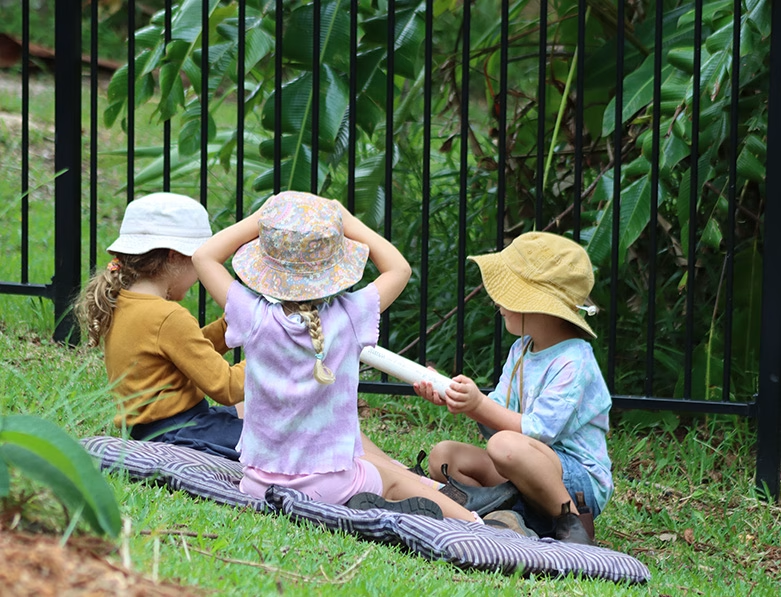
As we are in the middle of our Kindy interviews for 2027, our Kindy Coordinator and teacher would like to share her thoughts from her experience at the recent Vital Years Steiner early childhood education conference…
What is freedom in Steiner early childhood education? Over the holidays the school supported me to attend the Vital Years Steiner early childhood education conference at Warranwood Steiner school in Melbourne. The keynote speaker was Dr Michaela Glockler, an anthroposophical paediatrician. Being the head of the medical section at the Goetheanum in Switzerland for 20 years is only one of her many credentials when speaking about how to support the health and wellbeing of children in our modern world.
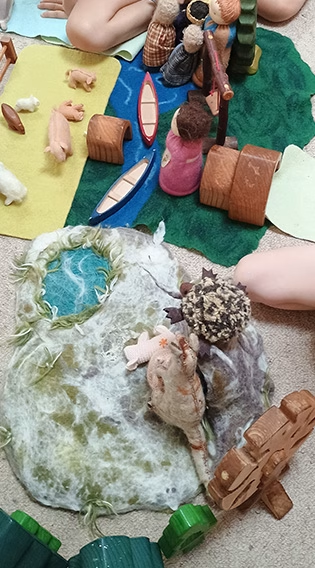
One of the ideas she presented to us was that children’s development is influenced by genetics and environment but also by destiny. What is each child’s task they have come to fulfill, how do we support them to unfold according to inner pre determination? She also spoke about the children needing to feel a warmth of connection and belonging in order to develop their individuality. In the Steiner kindergarten we create an environment of warmth. Soft colours and natural materials support the children’s sensory development. The children are surrounded by open ended resources that encourage them to engage fully in creative play. In “The Education of the Child”, Steiner says, “Through playing the child works freely to discover how the spirit must move to best shape their constitution according to inner predetermination.”
Being able to play creatively and deeply using capacities for imagination and imitation is only truly possible for a very short time in a child’s life. It is the basis for the development of creativity, initiative, communication skills and self determination. Free play is the foundation of the Steiner Kindergarten curriculum.
In order to play freely the children need boundaries…
Clear and strong boundaries help the children to feel safe. A fence around the garden helps them to know the boundaries of their play area.
Clear expectations of behavior helps them to learn acceptable ways of human interaction. Walking feet inside, gentle hands, caring for our environment and for each other. A repetitive and consistent rhythm helps them to know what happens when, every day.
Clear and consistent consequences are also important for when boundaries are crossed. We allow the children freedom within the boundaries.
We as adults need to have the ability to discern what is healthy for the children and need to uphold the boundaries with our loving guidance. Through our own inner work as teachers we strive to bring our own sensory world into balance.
In this way we can do our best to guide the children from a place that is free from our own biases. From our freedom we guide the children towards their own freedom. It’s definitely a work in progress.
– Katrina Ross, Kindergarten Coordinator

